
What Does India’s Youth Really Need?
Posted by Tushar Gandhi on Sep 10, 2013 in Blog | 0 comments
India is a young nation, and a nation of the young. If pundits are to be believed, it is time to hand over the reins of the nation into the hands of the youth and let them forge a nation of their dreams and expectations. But is there a single, common, united face of young India? Like everything else Indian, unfortunately not, as Gandhi’s great grandson Tushar Gandhi explains passionately …
Source: Tushar Gandhi Oped: Financial Chronicle India
Columnists write about the power of the youth. In the recent past, youth power has been apparent on the streets of India  and it even seemed as if the nation’s young were restless and ready to rise. However, if one looks at the history of youth movements, one realises that sooner or later, the harsh realities of life have taken a toll and smothered the exuberance of the youth.
For instance, the Nav Nirmaan Andolan in Gujarat was spearheaded by young student leaders fed up of what they considered to be the misrule of the then administration, and in particular, the chief minister of the state, Chimanbhai Patel. But after succeeding in getting him dismissed, the movement rapidly disintegrated. Soon its leaders were lost and the movement became a thing of the past.
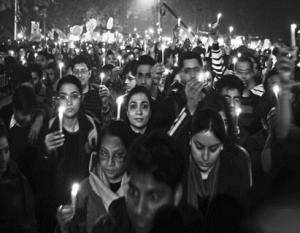
Young protesters hold candles during a rally in New Delhi / PHOTO: AFP
In 1974, the JP Movement was largely fuelled by youth from India’s universities. They were in the forefront of the unrest and the underground movement against Indira Gandhi’s Emergency. But when the Emergency was lifted and the Janata Party swept into power, it had no place for the youth. The young leadership was disbanded and dispersed.
Then came VP Singh’s execution of the Mandal Commissions recommendations on the implementation of reservations and enhancements of the reservation quotas in higher education. This split the community of students, and both pro and anti-Mandal groups took to the streets. Pitched battles were fought on the central thoroughfares of metros and capital cities. The passion was like an inferno and for a few days, it felt as if the edifice of reservations would be swept aside. But then, the steam went out of the sails of the movement. The revolutionary fervour and ardour dissipated and vanished.
In the aftermath of the 26/11 terror attacks on Mumbai, there was palpable anger against the political caste in the city. Several rallies were staged and on one day, there was an almost spontaneous gathering of thousands at the Gateway of India since there was a lot of anger and frustration against the political class. However, all these morchas were as short lived as the candles that were lit for exhibiting grief and anger; they sputtered and burned sporadically and briefly, and were then snuffed out.
When Anna Hazare took to the streets of the national capital to fight against corruption and demand for the implementation of the Lok Pal bill into a law, the youth took to the streets with utmost zeal and fervour. For a few weeks, it felt as if the much desired and vaunted revolution had begun. The Anna tsunami swept the nation and young India was at the forefront. But sadly, as rapidly it had gathered mass and momentum, so did it collapse and dissipate.
Last year in December, when a young girl was kidnapped and raped by a gang of depraved men, brutalised and left by the roadside half dead, her plight ignited fury and anger in young India. Thousands took to the streets while hundreds of thousands laid siege to the Rashtrapati Bhavan and paralysed the government. All over the nation, there was a rage that threatened to ignite an inferno, but it never happened. A few days and a few thousand candles later, it dissolved and fizzled out.
Why have there been so many ‘starts’ in a relatively young nation and why did none of them graduate into a revolution? A revolution that changed our nation or the society we live in? The reason is simple — none of them were sustained or strengthened by a resolve and an honest commitment. None of those movements could sustain themselves because the priorities, aspirations and ambitions of their constituents were different than those required to sustain a revolution. Carriers, packages and the race for material positions were much more sustained than the fervour to change or bring about a change.
As long as they are trapped in such circumstances and as long as their priorities are skewed, young India will never be the catalyst for change that this nation craves for.
——-
In 2005, to mark the 75th Anniversary of the 1930 Salt March, Tushar Gandhi organized a 241-mile walk for Peace, Justice and Freedom. 600 marchers from India, Pakistan, the US, UK and other parts of the world participated. Tushar founded the Mahatma Gandhi Foundation, and it was awarded in April, 2005, the 1st ‘Mahatma Mahaveer Award’ for promoting the ideals of Gandhi.
